Hall of Fame / Class of 2021 / Steve Slasor
Class of 2021
Steve Slasor
Steve “Slaz” Slasor helped establish competitive disc golf in Florida during the sport’s formative years.
About · Career · Photos & video · Museum objects · Florida history · Related people · Sources
About Steve Slasor
Steve “Slaz” Slasor helped establish competitive disc golf in Florida during the sport’s formative years. Winner of the first PDGA tournament in 1977 and the 1984 Masters world title, he combined championship results with the adaptable throwing skills of the early all-around Frisbee era. His Florida career connects the original Rockledge community, a fierce rivalry with Jeff Watson, and decades of competition across age divisions. He joined Ken Climo in the Florida Hall’s inaugural class in 2021. [1–5]
At a glance: PDGA #55 • Born 1948 • Florida connection: Palm Bay, Melbourne and Rockledge • Primary discipline: disc golf • International Disc Golf Hall of Fame: 1997 • Florida Hall: 2021. [1–3]
From recreational Frisbee to organized competition
In a 1989 interview, Slasor traced his interest to playing catch while attending Florida Institute of Technology in the early 1970s. After moving to Seattle, he met Ralph Williamson and Jeff Jorgenson and encountered organized competition. At the 1976 Washington State event at Woodland Park, he won golf, distance and accuracy. Returning to Florida in the late 1970s brought him into competition with Jeff and Mark Watson. The interview identified his occupation as a chemist. [8]
A place in the first PDGA tournament
Slasor won the 1977 tournament at a KOA campground outside Mobile, Alabama, recognized in the PDGA’s historical results as its first event. Tom Monroe directed the tournament and finished second. The contemporary report in Frisbee World described a 72-hole competition played over four rounds through a pine forest. Slasor earned $210; Monroe received $160, with Jim Howard, Randy Osborn and Ken Headrick completing the next three places. [4, 9]
The event belongs to the transition from loosely connected Frisbee competitions to a more formal professional disc golf circuit. Its significance is not simply that Slasor won an early tournament: his name occupies the first winner’s position in the PDGA event record. The Florida Hall’s induction text also identifies it as the first disc golf tournament he played. That description is narrower than his documented participation in the golf component of an all-around event in Seattle the previous year. [1, 4, 8]
Continue reading the biography
Frisbee World’s 1977 coverage places him in the wider flying disc circuit as well. At the Florence, Alabama, Eastern National event, he won the golf competition and the distance contest, with a reported throw of 304 feet. In Tampa, he finished third in golf behind Jeff Watson and Peter Bloeme. These results show why his story belongs in a flying disc hall that embraces more than one discipline: golf developed alongside accuracy, distance and other field events, and Slasor competed across that shared culture. [9]
Rockledge and the rivalry with Jeff Watson
The Florida newsletters document a competitive scene built through repeated local encounters. At the Rockledge Pro-Am in 1983, Slasor beat Tim Willis by one stroke. The Revolutionary Flyer identified that tournament as Florida’s only PDGA event that year. Slasor also won Rockledge’s fifth-anniversary event, ahead of Gregg Hosfeld and Jeff Watson, and a later Rockledge tournament in which John David and Gary Bancroft followed him in the results. [10]
Watson was a recurring obstacle. In two Rockledge meetings during 1983, Watson defeated Slasor in playoffs; one ended with Watson’s winning putt on the twenty-second hole. At the state championship, Watson’s 186 edged Slasor’s 187, with Willis third. These close finishes give substance to the rivalry: Slasor’s Florida reputation was formed through repeated contests with the same exceptionally strong group, rather than through isolated victories. [10]
The competition also reached beyond Rockledge. At the Altamonte Springs Discmasters in 1983, a temporary nine-hole basket layout hosted an early Orlando tournament. Slasor won, followed by Hosfeld and Nick Hart. Such events brought established players into parks that did not yet have permanent courses and helped connect local communities into a statewide tournament culture. The same newsletter thanked Slasor, Bob Aviles, Willis, Hart and Steve Harrison for their assistance and dedication. [10]
Florida victories before the 1984 world title
Slasor opened 1984 with another close contest against Watson at the Loch Haven Open in Orlando. Tournament director Bret Segrest’s account described an eighteen-basket temporary course shaped by live oaks, mandatory routes and out-of-bounds areas. Slasor and Watson were tied after three rounds. Slasor ultimately finished at 208 to Watson’s 211; the report singled out his roller from the eighteenth tee during the decisive play. Nick Hart secured third in a playoff. [10]
At Coconut Grove’s David Kennedy Park later that season, Slasor and Hart tied at 205 on a layout combining nine permanent and nine temporary holes. Their playoff lasted two holes. Slasor made a twenty-foot putt; Hart’s longer attempt landed on top of the basket. Read together, these reports preserve more than a sequence of trophies. They show the kind of precision under pressure that helped define Slasor’s reputation, and the improvised tournament settings in which Florida disc golf developed. [10]
World champion in Rochester
At the 1984 World Championships in Rochester, New York, Slasor won the Masters division with a total of 244, ahead of Snapper Pierson at 250 and Tom Monroe at 252. He also finished seventh in Open. The Florida Hall’s induction account emphasizes the physical demands of competing in both divisions, describing four rounds in a day. His Masters victory and Open placing should be understood together: he competed successfully for an age-division title while remaining competitive against the leading Open field. [1, 5, 15]
The historical division is identified here as Masters, the name used in the official event record. Applying the present-day MP40 age definition to this 1984 competition would be misleading; the Hall citation records Slasor’s birth year as 1948. [2, 5]
Skill, temperament and the original Rockledge course
Slasor’s 1989 interview stressed understanding flight, carrying useful shot options and maintaining a calm competitive approach. He recalled developing his own short-range turbo approach in the late 1970s. That recollection describes his personal development of the shot, not a claim that he alone invented it. His international Hall citation later emphasized his throwing versatility, trick shots, sportsmanship and support for the PDGA. [2, 8]
Rockledge’s local publications preserve the evidence behind that reputation. In 1985, Slasor won the Thanksgiving Jamboree with 94, two strokes ahead of Willis. The newsletter’s player-average listing put him at 48.00, ahead of Hart at 48.33 and Tom Krajna at 49.33. That was a specific local statistical snapshot, not a national ranking, but it illustrates how closely the community followed consistency as well as individual wins. [12]
When the original Rockledge course closed in 1987, its retrospective newsletter credited Slasor with both the two-round and four-round course records. He won the final PDGA tournament there, a gathering reported to have drawn ninety competitors from twelve states, with John Andrews second and Hosfeld third. He also won the last Pro-Am, ahead of Andrews and Bob Lewis. Those closing results make him a central figure in the history of a course that anchored the early Florida scene. [11]
World doubles and a long Florida career
Slasor added world doubles championships to his singles title. In the 1988 Worlds Masters doubles competition, he and Tom Monroe totaled 84 to win. In the 1992 Masters doubles results, the official PDGA record lists Slasor and Glenn Dooner as the winning pair at 80, one stroke ahead of Snapper Pierson and Glenn Triemstra. The partner distinction matters: later biographical accounts sometimes associate Monroe with the 1992 title, but the event record names Dooner. [6–7]
His Florida results continued well beyond the original Rockledge era. The PDGA record lists Florida State victories in Open during 1985–1988 and Masters in 1994 and 2000. His winning record also spans Melbourne, Barnett Park and Orlando events, followed by Grandmasters victories at the Florida Masters Championships in 2011 and 2014. The categories changed, but the record documents sustained participation across several generations of Florida competition. [3]
Recognition in two halls
Slasor entered the international Disc Golf Hall of Fame in 1997. Its citation celebrated both his competitive record and the character of his play, describing a versatile competitor admired for consistency and sportsmanship. In 2021, Florida’s new Hall selected Slasor and Ken Climo as its inaugural inductees. The pairing connected an early architect of the state’s competitive reputation with the player who later became its most widely recognized world champion. [1–2]
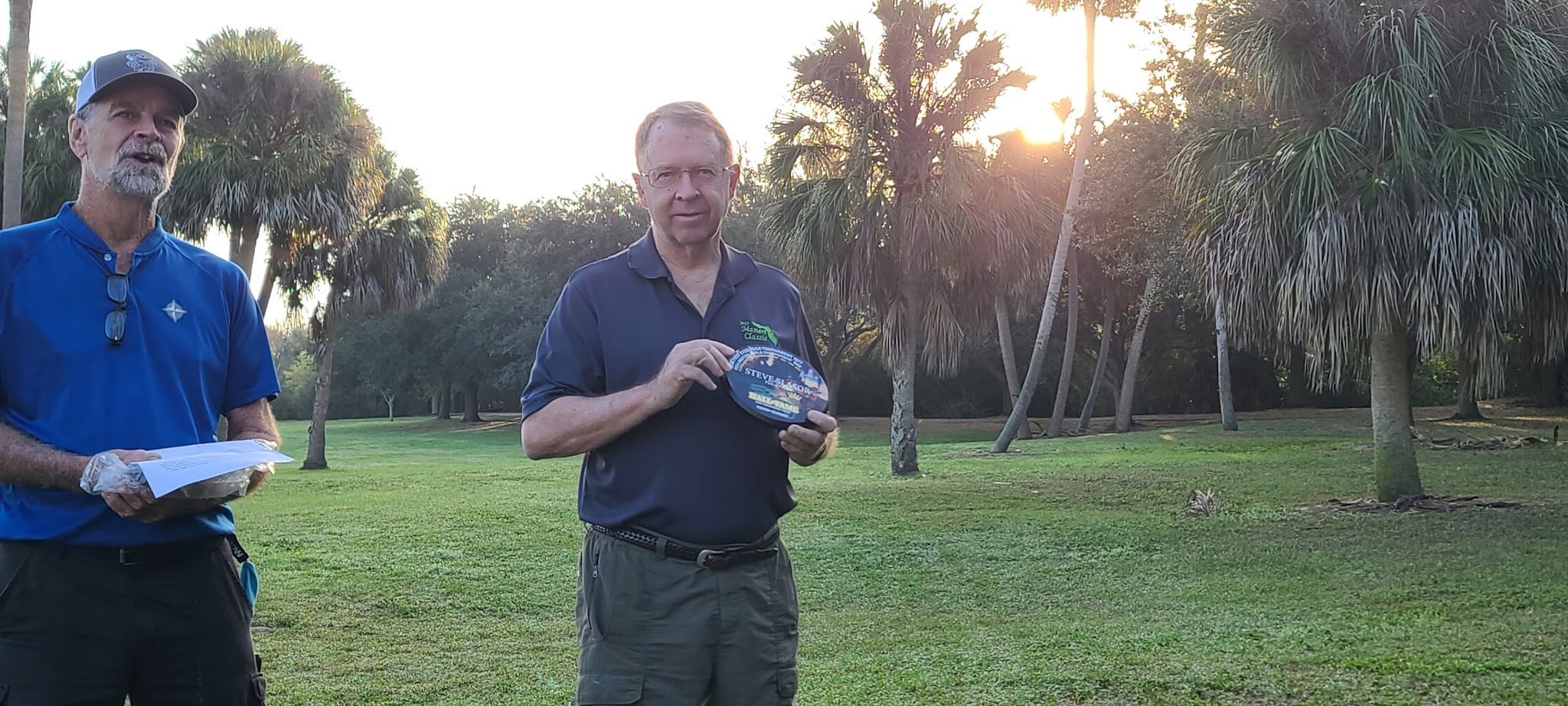
The Florida induction material and surviving commemorative artwork provide institutional evidence for Slasor’s place in that first class. They also supply objects through which the museum can tell his story: the award design, the finished commemorative disc, and eventually a photograph of the displayed plaque. These objects complement tournament records by documenting how Florida chose to remember and honor one of its pioneers. [1, 14, 16]
The basics
Year inducted
Florida connection
Palm Bay, Melbourne, and Rockledge
Explore this Florida history →
Disciplines
PDGA record
The Hall plaque
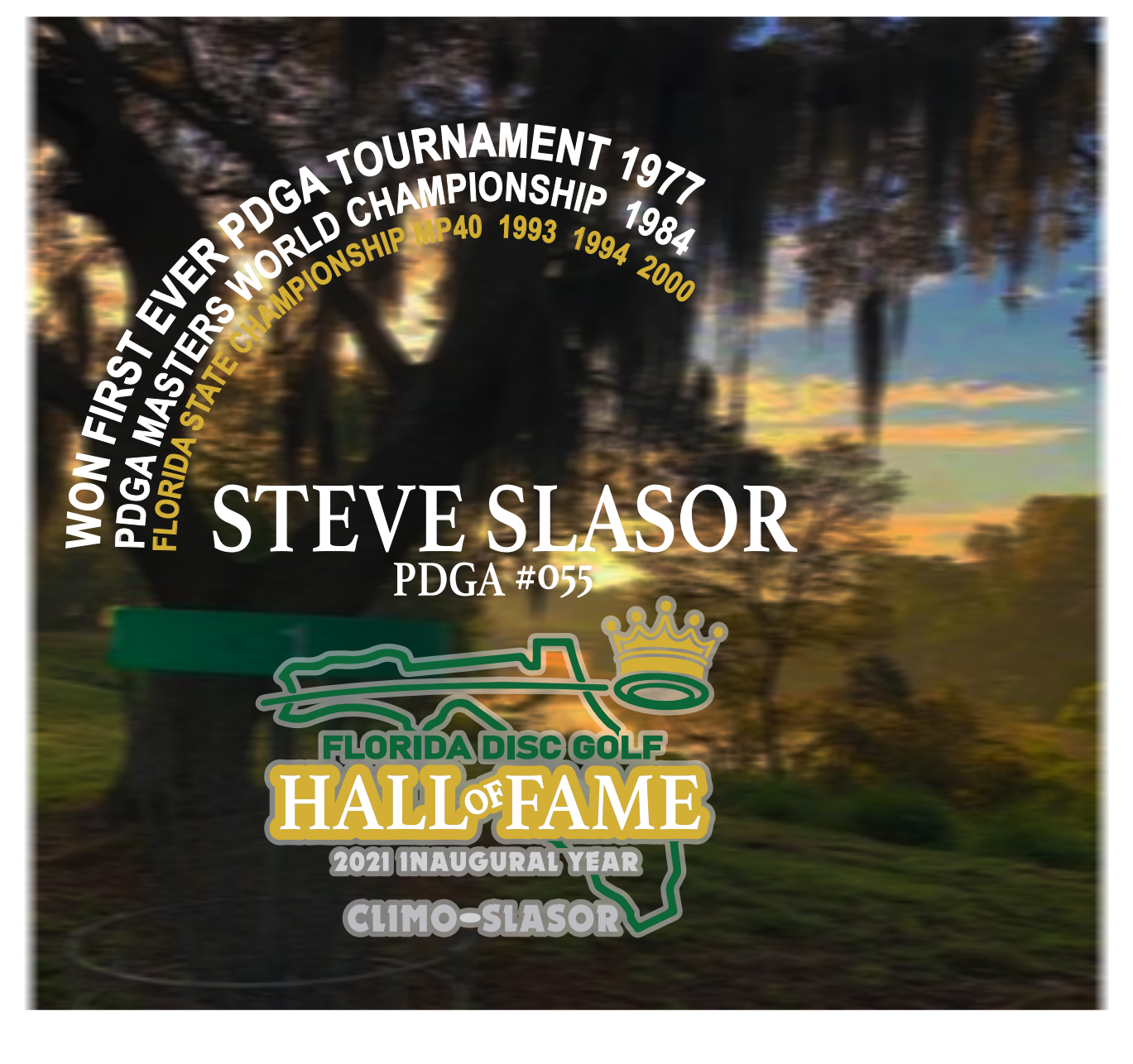
Slasor’s inaugural Florida Hall artwork commemorates his 1977 PDGA victory, 1984 Masters world championship and Florida championship record. It preserves the institution’s original name, Florida Disc Golf Hall of Fame, and identifies the inaugural pairing of Climo and Slasor. The current institution is the Florida Flying Disc Hall of Fame. [1, 14]
Career at a glance
World Championships
All world titles are grouped here, with the historical division, year and format. Doubles partners are recorded explicitly. [5–7]
| Year | World championship | Division | Format / partner |
|---|---|---|---|
| 1984 | PDGA Worlds | Masters | Singles |
| 1988 | Worlds doubles | Masters | Doubles — Tom Monroe |
| 1992 | Worlds doubles | Masters | Doubles — Glenn Dooner |
Other World Championship results: seventh in Open at the 1984 Worlds, alongside his Masters title; ninth in Open at the 1989 Worlds. These are placements, not additional world titles. [15, 17]
Florida State Championships
The following wins are identifiable as Florida State Championships in the PDGA career record. Historical division names are retained. [3]
| Year | Championship | Division |
|---|---|---|
| 1985 | Florida State Championships | Open |
| 1986 | Florida State Disc Golf Championships | Open |
| 1987 | Zimbobway Open — Florida State Championships | Open |
| 1988 | Florida State Disc Golf Championships | Open |
| 1994 | Florida State Disc Golf Championships | Masters |
| 2000 | Florida State DG Championships — Pros | Masters |
The 2021 Hall artwork additionally lists a 1993 Florida State Masters championship. The corresponding PDGA win is named Florida Flying Disc Championships, and the contemporary FDGA report lists Slasor first in Masters golf at 154. The relationship between those event names needs reconciliation before adding a seventh state-title row. [3, 13–14]
Other National & Regional Achievements
1977 — Winner, inaugural PDGA tournament, Mobile, Alabama. [4]
1977 — Golf and distance wins at the Florence Eastern National event; third in golf at Tampa. [9]
1987 — Winner, final PDGA tournament at the original Rockledge course. [11]
2011 and 2014 — Florida Masters Championships, Grandmasters winner. These are listed separately from the general Florida State Championships. [3]
The PDGA career page lists 69 wins in its recorded results. This is a database count, not a claim that every tournament in his career is represented; contemporary newsletters document additional early competition. [3, 10–12]
Contributions & legacy
Slasor’s contribution is visible in three connected records: the early national circuit, the development of Florida’s tournament community, and sustained competition across divisions. His inaugural PDGA win places him in the sport’s organizational beginnings. The Rockledge and Orlando newsletters place him inside the local networks that kept events running, thanked players for practical help, and created a written history of the emerging sport. His Hall recognition adds the testimony of peers who valued sportsmanship and throwing skill as well as results. [2, 4, 10–11]
For the Florida Flying Disc Hall, his biography should preserve those connections. The story is strongest when a championship table sits beside contemporary reporting, course history and museum objects. It can show visitors not only what Slasor won, but how the game was played and sustained in Florida before a mature professional tour existed.
Photos & video
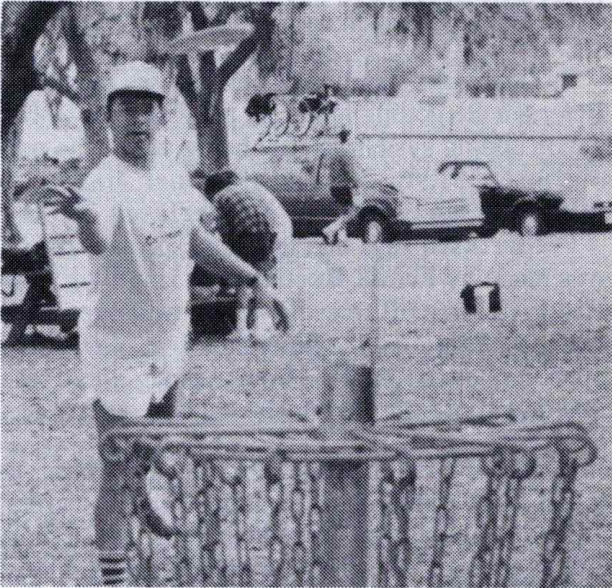
From the National Disc Golf Museum
Steve Slasor’s Florida Hall commemorative disc
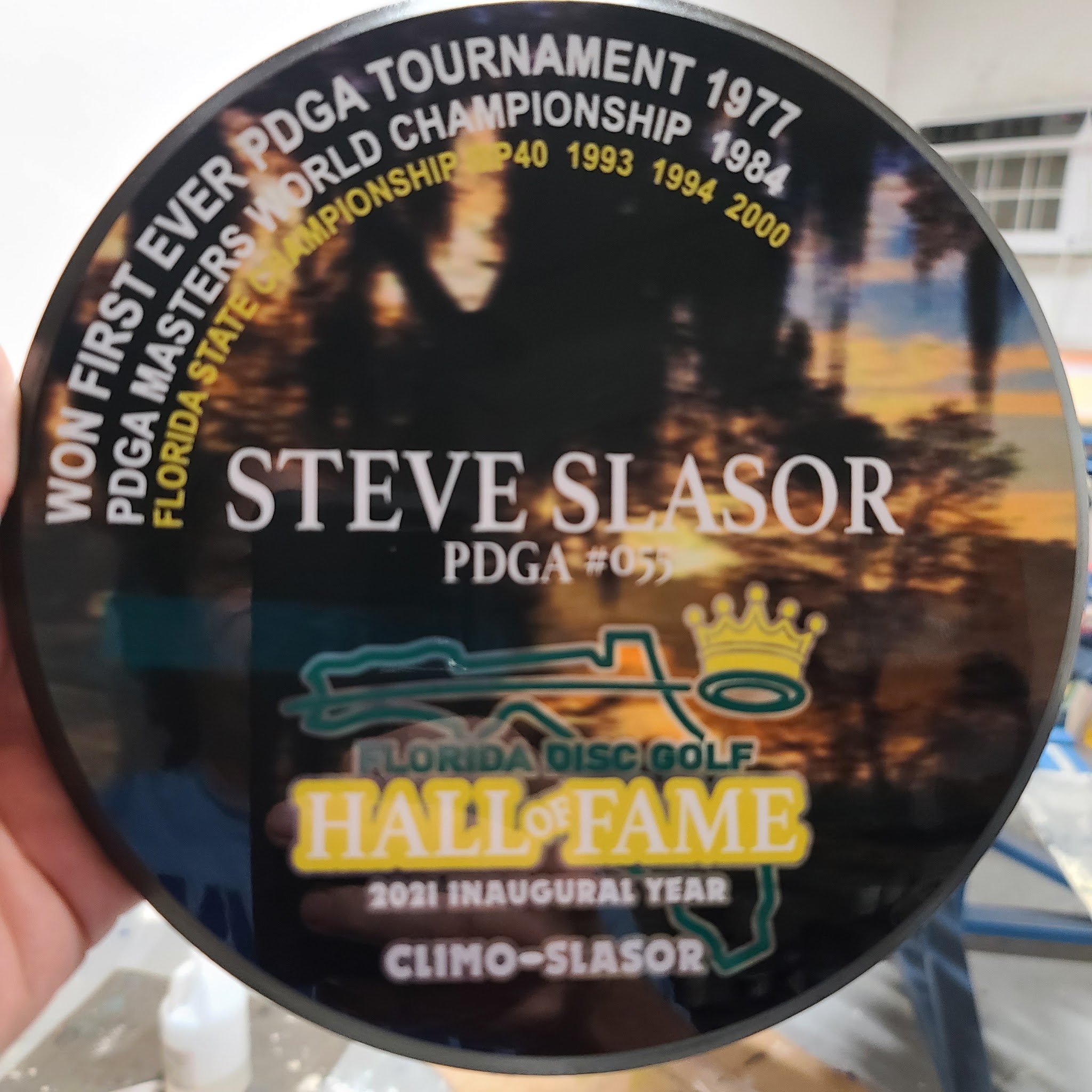
The finished commemorative disc brings Steve Slasor’s inaugural Florida Hall recognition into the museum’s object collection. Its printed design names the honoree and presents the Hall’s recognition through the familiar form of a flying disc. Read it alongside Slasor’s biography and the Class of 2021: the object commemorates the honor, while the historical sources document his playing career and service to Florida disc golf. The archive also preserves the production artwork, a separate record of how the design was prepared.
Explore Hall collection highlights →
See it at the museum
Consult the museum’s visitor information before planning a visit. Online photographs and collection features do not indicate which objects are currently on display.
The Florida history exhibit
Stories & Florida history
Steve Slasor’s story connects with Palm Bay, Melbourne, and Rockledge. Explore the people, communities, and disciplines alongside this biography.
Sources & further reading
Open sources and further reading
1. Florida Hall original induction text (2021). Native source document follows.
Copy of Hall of Fame introduction 2021
2. PDGA — Steve Slasor, Disc Golf Hall of Fame, class of 1997.
3. PDGA — Steve Slasor #55, career wins. Historical database coverage is incomplete.
4. PDGA — inaugural 1977 tournament results, Mobile.
5. PDGA — 1984 Worlds Masters results.
6. PDGA — 1988 Worlds doubles results.
7. PDGA — 1992 Worlds doubles results.
9. Frisbee World, July/August 1977 — contemporary national-event coverage, including Mobile, Tampa and Florence.
10. The Revolutionary Flyer, vol. 1, no. 2, circa 1984 — Florida 1983–1984 results and reporting.
11. Rockledge Disc Golf, vol. 7, no. 1, January 1988 — retrospective on the original course and its final season.
12. Rockledge Disc Golf, vol. 5, no. 1, January 1986 — 1985 Jamboree and player averages.
13. FDGA newsletter, October 1993 — Florida Flying Disc Championships results.
14. Museum archive — “slasor trophy v1.pdf,” inaugural Hall artwork.
15. Disc Golf World News, no. 71, fall 2004 — reprint of Ace Mason’s 1984 Worlds reporting.
16. Museum archive — finished commemorative disc, “20220101_182130.jpg.”
17. PDGA — 1989 World Championships, Open results.
18. Museum Drive archive — induction photograph, “20220102_080250.jpg.”
19. Print Library — Disc Golf World News, vol. 3, no. 1, Spring 1989, pp. 30–33; photograph on p. 30.
About this biography
Biography in progress. This member page is being prepared from the Hall’s existing research and induction records.